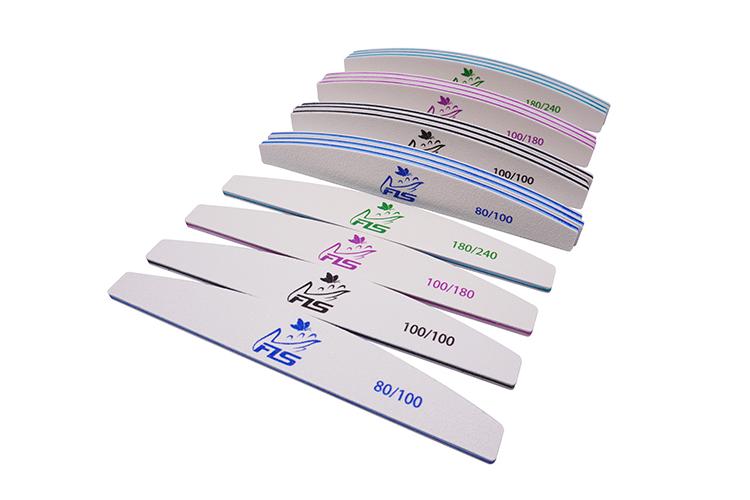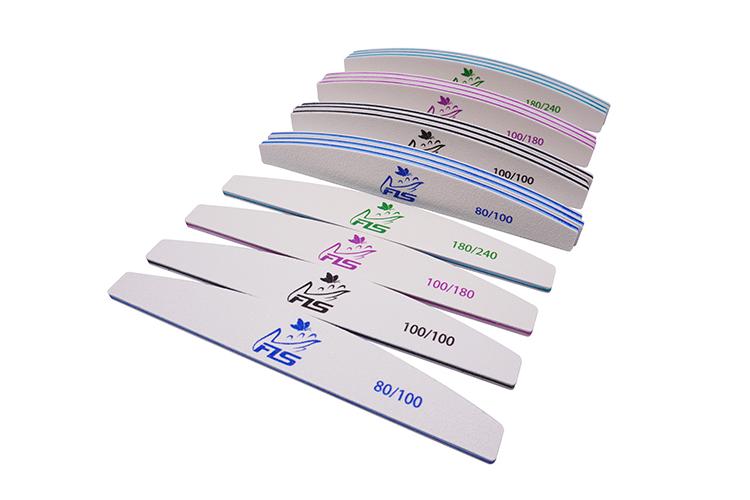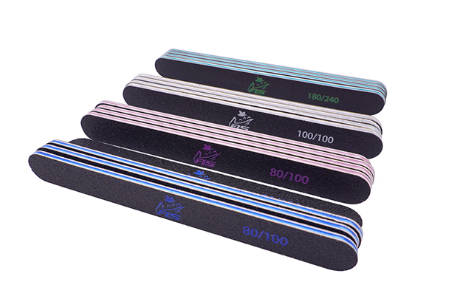
For salons, distributors and private-label buyers, emery boards for nails are more than simple filing tools. Their abrasive surface, core construction, grit pairing, shape and packaging all affect how a product fits a service menu or retail range. This guide explains how emery boards for nails are built, how to compare formats and how to create a practical assortment without relying on unsupported claims.
What Are Emery Boards for Nails Made Of?
How Do Sandpaper, EVA and Plastic Cores Work Together?
An emery board nail file normally combines an abrasive paper surface with a supporting core. Common constructions use sandpaper, EVA and a plastic board. The abrasive layer performs the filing, while EVA can add cushioning and flexibility between the surface and the board. A thicker plastic core generally feels more rigid in the hand, so core thickness should be reviewed together with the target customer and intended service.
The nail file material also affects customization. A paper-backed surface can carry printed graphics, while the core provides the shape and handling profile. Buyers should request a sample to review edge finishing and print consistency before approving a production sample. For B2B programs, emery boards for nails should be evaluated as a complete construction rather than by abrasive paper alone.
Are Emery Boards Different From Other Nail Files?
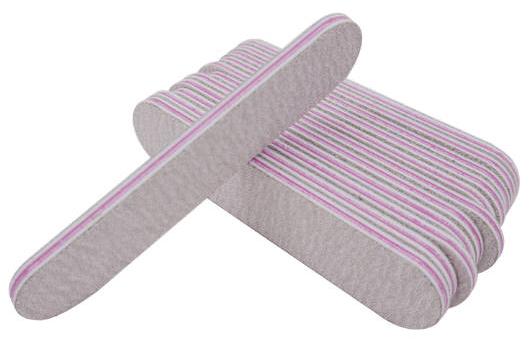
An emery board nail file belongs to the broader nail-file category, which also includes sandpaper, wood, glass, metal, polishing and sponge formats. The difference is mainly the abrasive surface, support structure and intended handling experience. A paper-based emery board nail file is often easier to specify in different shapes, grit combinations and printed designs.
For buyers comparing emery boards for nails, the key questions are practical: Does the file feel stable? Is the abrasive layer evenly bonded? Can the supplier repeat the same grit and shape across a bulk order? These checks are more useful than choosing a file only because of its appearance.
Which Emery Board Grit Numbers and Types Fit Each Use?
How Does the Emery Board Grit Scale Work?
The emery board grit scale is read in the same general direction as other abrasive products: a lower number indicates a coarser surface, while a higher number indicates a finer surface. In the documented product range, common options include 60, 80, 100, 120, 150, 180, 240 and 320 grit.
This means emery board grit numbers should be reviewed as part of a service plan. A lower grit may remove material more quickly, while a higher grit supports more controlled finishing. The exact result also depends on pressure, filing direction, nail condition and the material being shaped. A buyer should therefore approve samples instead of assuming that one grit works for every customer.
When Should Buyers Choose Coarse Emery Boards or Fine Options?
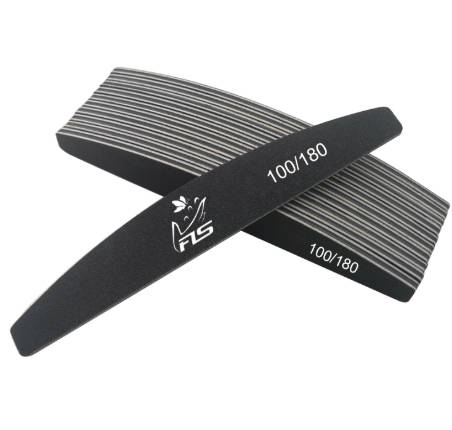
Coarse emery boards can be considered when the product range needs a stronger shaping option. The documented product range includes 80- and 100-grit configurations for several buffer formats, while 180- and 240-grit options are used in finer combinations. A 100/180 file, for example, gives a buyer two surface levels in one tool, but the two sides should be labeled clearly.
Fine options are useful when a service requires more controlled edge refinement. For a wholesale assortment, a practical range can include a coarse option, a dual-grit option and a finer finishing option. This gives salons and distributors more choice without forcing every customer to buy the same specification.
Which Sizes and Formats Make Sense for Bulk Nail Care?
Are Mini Emery Boards and Small Emery Boards Useful for Promotions?
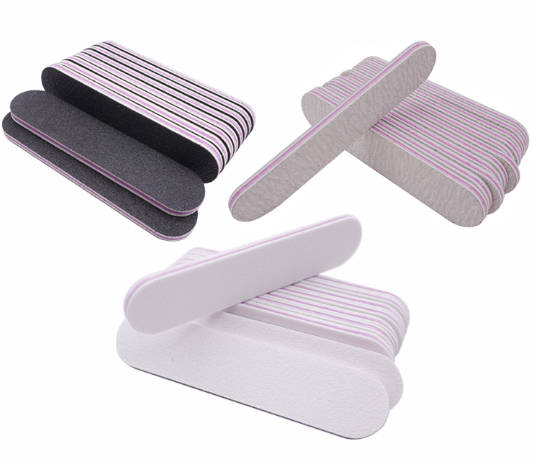
Mini emery boards and small emery boards can suit trial kits, travel sets, event gifts and promotional packs. One documented mini buffer measures 3.5 × 2.5 × 1.2 cm and combines high-elastic sponge, EVA and emery. Other small formats are recorded at approximately 6.0 × 3.0 cm.
For promotional mini emery boards, buyers should check whether the reduced size still allows comfortable handling. The product should also have enough surface area for the selected grit and artwork. A mini file can support a campaign or sample program, but the final choice should match the expected use rather than being selected only for a low unit volume.
When Do Custom–Shaped Emery Boards Improve Product Differentiation?
Custom-shaped emery boards can help a product line look distinct when the shape supports a genuine use or packaging concept. Documented format options include straight, curved, half-moon, diamond, square, wave and mini shapes. Customization may also include size, color and packaging, subject to order confirmation.
For emery boards for nails, shape decisions should be linked to handling, storage and retail presentation. A curved edge may support access around the nail contour, while a compact shape may fit a gift kit. Buyers should approve a physical sample because artwork dimensions, edge smoothness and usable abrasive area can change when the outline is modified.
How Should Businesses Buy, Pack and Position Emery Boards?
Should Buyers Choose Disposable Emery Boards or Washable Construction?
Disposable emery boards may fit a salon policy that assigns one file to one client or one service. However, “disposable” should be treated as a purchasing and hygiene decision, not as an automatic description for every paper-based file. Washability depends on the construction and abrasive material.
The documented product information identifies some Japanese sandpaper surfaces as waterproof and washable. That fact should not be extended to products that use a different abrasive layer. Buyers should ask for the confirmed cleaning method, test the sample and align the result with salon procedures before printing hygiene claims on packaging.
How Can Buyers Evaluate Marketplace Emery-Board Listings?
Searches for marketplace emery-board listings often show many similar-looking products. Wholesale buyers should compare the actual specifications: core material, abrasive range, dimensions, shape, pack count, logo method, packaging and sample policy. Product photographs alone cannot confirm grit consistency or bonding quality.
A supplier should also explain how a pre-production sample is approved before the bulk order. This step helps a buyer check the filing feel, print placement and pack presentation before the same specification is repeated across a shipment. A clear specification sheet is more valuable than an unverified marketplace claim.
How Can Felice beauty Support Custom Emery Board Programs?
Which Felice beauty Emery Board Formats Can Buyers Review?
Felice beauty offers documented nail-file and buffer formats using combinations such as plastic board, EVA, sandpaper, Japanese sandpaper and sponge. The recorded range includes standard files around 17.8 cm long, mini buffers, dual-grit configurations and custom-logo surfaces.
For buyers building emery boards for nails assortments, the available product records include 60–240 grit options, 80–320 grit options and specific 100/180 configurations. The exact stock status, color, shape and pack format should be confirmed for each order.
How Do We Help Buyers Confirm Logo, Packaging and Samples?
We support discussions around custom logo, shape, size, color, packaging and labels where the requested format is available. Several documented nail-file models use a 1.8 mm plastic board with EVA and sandpaper, and some records specify 25 pieces per pack. A recorded MOQ for several custom designs is 1,000 pieces per design.
We also use pre-production samples as a quality-check step before bulk approval. Our buyers can review the grit, edge, artwork and packaging plan together, then confirm the final specification. This process helps a private-label program keep emery boards for nails consistent across future orders.
FAQ
Q: Are mini emery boards suitable for professional kits?
A: Mini emery boards can suit trial kits, travel packs, event gifts and promotional sets. Buyers should confirm the size, abrasive surface, artwork area and grip before choosing a mini format for regular salon use.
Q: Are coarse emery boards better for every nail type?
A: No. Coarse emery boards remove material more aggressively, but the suitable choice depends on the nail material, service step, pressure and technician method. A sample review is recommended before bulk approval.
Q: Can emery boards be customized for a private-label program?
A: Custom logo, shape, color, size and packaging can be discussed for eligible products. MOQ, artwork requirements, pack count and any setup cost should be confirmed before production.